Zero Introspection

Marc Andreessen of Andreessen Horowitz recently told a podcast audience that he operates with "zero" introspection.

Move forward. Go.

He credited Sigmund Freud with manufacturing the modern habits of second-guessing and self-criticism, and argued that the great men of history never wasted time on such things.

It is a crisp line. And it has the satisfying shape of a contrarian truth.

But I have spent years watching sharp, driven people in rooms together, and I have noticed something Andreessen's framing leaves out: the founder who cannot read the room, the executive who keeps making the same hire, the investor who cannot figure out why his best people keep leaving. These are not people who dwell too much on themselves. They are people who have never seriously tried.

Tasha Eurich, an organizational psychologist, found that while 95% of people believe they are self-aware, only about 10-15% actually are. The gap shows up in decision quality, in relationships, and in how people lead. Andreessen is right that excessive rumination is a trap. But he has conflated rumination with reflection, and that is a meaningful distinction.

There is also the question of what "moving forward" means if you carry the same blind spots from one decision to the next. Speed is not the same as progress.

I am not sure Andreessen is entirely wrong. There is something to the idea that high performers trust their instincts and do not overanalyze every choice. The question is whether that posture is a cause of their success or a story they tell afterward.

Which brings me to what I keep thinking about: If self-awareness is genuinely useful, why do so many of the people who need it most remain convinced they already have enough?

-Marc

+ Brigadoon organizes gatherings for founders, investors, journalists, doctors, designers, architects, and civic leaders. No PowerPoints, no panels, no name tags. Just a deliberately varied group in conversation, with radical curiosity as the only agenda, and an honest acknowledgment that the ROI is unknown, and that is exactly the point.
When the ceremony isn't enough

17.9 million people watched the Oscars on Sunday. That sounds like a lot until you note it was 9% fewer than the year before, in a year with no real controversies and no shocking upsets. The kind of night the Academy probably thought it wanted.

There is something worth sitting with there. A clean show, a stable broadcast deal with ABC and Hulu through 2028, and the audience still shrank. Conventional wisdom says controversy drives ratings. Will Smith. Political speeches. Memorable moments that become Monday morning conversation. The 2025 ceremony had its share of those and drew nearly 20 million. This year, relative calm, and nearly two million people quietly stayed home.

Meanwhile, the Academy has already made its bet on what comes next. Starting in 2029, the ceremony moves to YouTube. Not cable. Not a broadcast network with 70 years of Sunday night habit behind it. A platform built on infinite scroll and algorithmic discovery, where the audience decides what matters and no institution gets deference just for showing up.

I have spent years thinking about what happens when formats outlive the cultures that created them. The Oscars is not just a TV show. It is a credentialing ceremony for an industry that still believes its own judgments carry weight. But credentialing only works when the audience agrees to show up and recognize the credential.

The move to YouTube is not simply a distribution decision. It is a renegotiation of authority. The Academy is asking YouTube's audience to care about the Academy's verdicts. Whether that audience accepts the trade is genuinely unclear.

When a legacy institution moves to a new platform to reach its audience, is it adapting, or quietly conceding that the audience has already decided it doesn't matter?

-Marc

+ Brigadoon is a small annual gathering built around real conversation: no PowerPoint slides, no panels, no name tags, and no clear ROI. The only requirement is genuine curiosity.

Last Call

Restaurants are losing the bar tab — and nobody saw it coming.

Alcohol has been the financial backbone of the American dining industry for decades. A $14 glass of wine costs the restaurant roughly $3. The margin on a cocktail makes the margin on a steak look modest. For most full-service restaurants, the bar subsidizes the kitchen. Always has.

Not anymore.

Americans are drinking less. Not dramatically, not all at once — but measurably, consistently, and across demographics. The shift isn't driven by a single cause. It's a combination of GLP-1 medications blunting appetite and cravings, a generation of younger consumers who never developed the drinking habits of their predecessors, and a broader cultural recalibration around wellness that is showing up in behavior, not just in surveys.

The bottom line is, well, the bottom line. Restaurants that built their economics around alcohol as a margin engine are now staring at a structural gap that a better cocktail menu won't close.

Here's what I keep thinking about: this isn't a restaurant story. It's a story about a business model built on a behavioral assumption that quietly stopped being true. Every industry has a version of this. A revenue stream that feels permanent until it doesn't. A customer behavior that felt locked in until it shifted. The assumptions that get buried deepest are the ones that have never been wrong before.

What behavioral assumption is your business model quietly built on — and when did you last actually test it?

-Marc

Brigadoon is small gatherings. Radical curiosity. No PowerPoint slides. An unknown ROI. The kind of conversations you'll still be turning over in your head six months later. If that sounds like your kind of room, you're probably the kind of person we're looking for.

Monday Evening at Sundance: One of One

Since 2013, I've made Monday evening at the Brigadoon gathering in Utah a tradition: screening a thought-provoking documentary in Sundance Mountain Resort's historic screening room—the original home of the Sundance Film Festival.

Past films have included Caucus, A Faster Horse, and James Beard: America's First Foodie. Each sparked hours of conversation that extended well beyond the screening itself.

I seek out documentaries that focus on commitment, excellence, and uniqueness in an increasingly homogenized world.

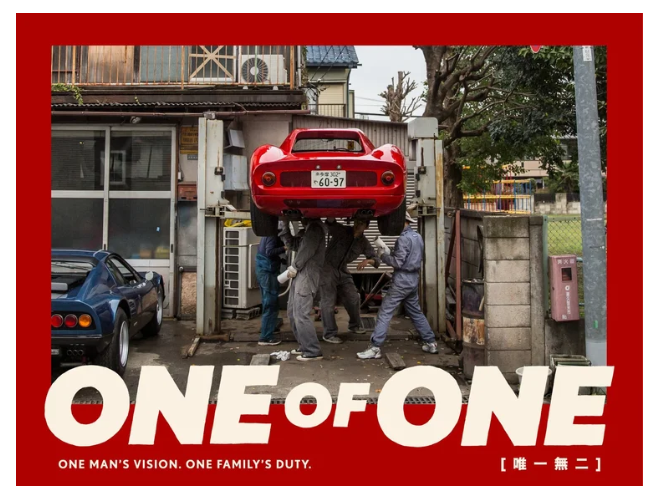
This year's documentary screening will be One of One.

One of One offers unprecedented access to Naito Auto Engineering, one of Japan's best-kept automotive secrets.

Founded in post-WWII Tokyo, this three-generation family business has earned global renown for restoring high-value classic cars with artistry and precision. Masao Naito transformed his father's local mechanic shop into a first-class operation coveted by top collectors worldwide. But after 40 years of iron-fisted leadership, his retirement looms, revealing cracks in the family foundation. Do the younger Naitos have what it takes to keep the family together and carry the business forward?

Filmmaker Ben Bertucci captures fly-on-the-wall footage of this notoriously secretive business, including never-before-seen artisanal restoration techniques passed down from founder Shinichi Naito, a self-taught "genius" who worked on Japanese bomber planes during WWII.

Watch the trailer here.

See you in Utah.

-Marc