

Uber can't find my house.
A company with 22,263 worldwide employees, a market cap of nearly $60 billion, and a CTO with two degrees from the Massachusetts Institute of Technology can't find my house.
Whatever mapping technology Uber drivers are using to find my residence, it is failing.
I have repeatedly used the company's app to inform them of this mistake, but now I just use my neighbor's address as my own to ensure less friction and delay.
Uber knows that errors in map data significantly impact the quality of their services, thus leading to suboptimal user experience.
Uber frequently touts investments and commitments to better maps - the company even hosts a blog called Uber Engineering complete with fancy graphs and algebra heavy mathematical formulas.
One such post on this blog, the company suggests it is working to improve mapping accuracy with CatchME.
You know CatchME.
CatchME is a concept created by a non-communications professional and most certainly by a committee of engineers looking to impress each other without regard to their end-users.
This committee of engineers looking to impress each other so enjoyed using CatchME as the premier mapping solution they blogged about it.
The need for CatchME explained in a Uber post from April 2019: "Reliable transportation requires a robust map stack that provides services like routing, navigation instructions, and ETA calculation. Errors in map data can significantly impact services, leading to suboptimal user experience. Uber engineers use various sources of feedback to identify map errors, for instance, machine learning models to log and understand user feedback, or by evaluating map metrics to improve map quality."
CatchME all sounds hyperbolically wonderful and technology-focused, yet Uber can't find my house.
Hey, Uber here's a useful end-user suggestion, how about less machine learning models and more twin-speed bikes.
This bike-focused model seems to work wonders in London.
Without a doubt, London's taxi service is the best in the world.
No doubt this is in part because cab drivers working in London must know the quickest routes through London's labyrinthine road network. There are thousands of streets and landmarks within a six-mile radius of Charing Cross - the junction in the city where six routes meet. Anyone who wants to drive an iconic London cab must memorize them all - they must have the Knowledge.
The guidebook issued to prospective cabbies by London Taxi and Private Hire (LTPH), which oversees The Knowledge test, summarizes the task like this: To achieve the required standard to be licensed as an "All London" taxi driver you will need a thorough knowledge, primarily, of the area within a six-mile radius of Charing Cross. You will need to know: all the streets; housing estates; parks and open spaces; government offices and departments; financial and commercial centres; diplomatic premises; town halls; registry offices; hospitals; places of worship; sports stadiums and leisure centres; airline offices; stations; hotels; clubs; theatres; cinemas; museums; art galleries; schools; colleges and universities; police stations and headquarters buildings; civil, criminal and coroner's courts; prisons; and places of interest to tourists. In fact, anywhere a taxi passenger might ask to be taken.
The Knowledge was introduced as a requirement for taxi drivers 154 years ago and mastering The Knowledge typically takes students three to four years.
The Knowledge is gained by traversing London on a foot, motor scooter, and bike -- remember this is all before they can get behind the wheel of a taxi.
Consider that to get behind the wheel of black London taxi someone probably logged more than 50,000 miles on a bike and foot, basically two circumnavigations of the planet, nearly all within inner London's dozen boroughs and the City of London financial district. Studying to be a London taxi driver, one needs to devote entirely to the challenge.
The Knowledge is not merely a matter of way-finding - the key is a process called "pointing," studying the stuff on the streets. Those successful in passing the exam have developed a system of pointing that some call "satelliting," whereby the New York Times reports, a candidate travels in a quarter-mile radius around a run's starting and finishing points, poking around, identifying landmarks, making notes. By this method, the theory goes, a Knowledge student can commit to memory not just the streets but the streetscape — the curve of the road, the pharmacy on the corner, the sign of a pub.
This taxi cab requirement process is unmatched anywhere in the world.
Sure anyone can access a GPS device to get around, and Uber drivers in Britain's capital are famously not required to learn the Knowledge to earn a license.
Who knows what Uber's requirement is in America beyond knowing how to powerup a smartphone.
Technology, engineering, and machine learning are all well and good, but the addition to a commitment to craft and walking the streets is necessary. The Knowledge isn't a simple process, but it provides a path to understanding how successful leaders are the ones able to process loads of online and offline information.
Eleanor Maguire, a neuroscientist at University College London, has spent 15 years studying cabbies and the Knowledge. The New York Times reports, she has discovered that the posterior hippocampus, the area of the brain known to be important for memory, is bigger in London taxi drivers than in most people and that a successful Knowledge candidate's posterior hippocampus enlarges as they progress through the test.
Maguire's work demonstrates that the brain is capable of structural change, even in adulthood. The studies also provide a scientific explanation for the experiences of Knowledge students, the majority of whom have never pursued higher education and profess shock at the amount of information they can assimilate and retain.
As you think about the team and company you are building, are you over-indexed on technology and discounting being in the streets?
The best performing among us excels equally at processing loads of online and offline information.
Uber's one-sided business technology model means they can't find my house.
Make sure the team and company you are building can find my house - embrace the Knowledge.
- Marc
Marc A. Ross is a strategist and advisor working at the intersection of globalization, disruption, and politics. Ross is the founder of Brigadoon.
Cuckoo, Adventure, Memes, Career

Brigadoon Weekly
December 1, 2019
Curation and commentary from Marc A. Ross
Reporting from Alexandria, Virginia
Cuckoo, Adventure, Memes, Career
ROSS RANT
Better to innovate, create, or aggregate?
A cuckoo bird could be seen as an odd inspiration for business success.
I mean, they’re also shameless parasites - who wants to be a part of that?
You see, many species of cuckoos have been known to leave their eggs in other birds’ nests. Their whole means of success depends on letting their young be raised by entirely different species.
Ornithologists used to think that cuckoos would simply wait for the opportune moment to lay their eggs in other birds' nests, but it turns out that cuckoos have more moxie than that.
In a study in the journal Ethology, researchers from the University of Granada found that the Great Spotted Cuckoo laid its eggs in the nests of magpies while the magpie was sitting on the nest. These researchers thought that magpies had just gotten sick of raising these ungrateful cuckoo birds and started sitting on their nests almost constantly while they were incubating their own eggs.
In Darwin-esque brinkmanship, the cuckoo basically called the magpie’s bluff and went for the crazy (cuckoo, if you will) option, laying eggs in another bird’s nest while the bird was still sitting there.
Even when magpies fought back with aggressive pecking, in every single instance, the cuckoo accomplished her mission and laid her eggs.
That is some moxie.
Which brings me to business models, LVMH, and Bernard Arnault.
Just this week LVMH announced that it had purchased the American icon Tiffany for $16.6 billion adding to his sprawling luxury goods empire.
The Financial Times reports the acquisition is the latest in four decades of voracious dealmaking by Arnault and marks the luxury sector’s largest deal ever. Tiffany, known for its robin’s egg blue boxes, will join a stable of LVMH brands that has diversified far beyond its roots in Christian Dior couture, Louis Vuitton luggage, and Hennessy Cognac to include Rimowa suitcases, make-up by pop star Rihanna, and even train journeys across Europe on the Venice Simplon-Orient-Express.
“Arnault is like a cuckoo: he moves in and takes over others’ nests rather than building his own,” says Dana Thomas, author of Deluxe: How Luxury Lost Its Lustre.
Arnault has never stitched a bag, designed a ring, or launched a product - he and his team have simply made them better.
Going from zero to one sounds sexy and will get you on the cover of magazines, but a better move might be to innovate and make something better.
Anyone who has launched a new product and tried to sell it knows how challenging this process is - even for the best funded, best organized blue-chip companies.
Thomas Steenburgh, a marketing professor at the University of Virginia Darden School of Business, was inspired by his early career at Xerox to discover why firms with stellar sales and R&D departments still struggle to sell new innovations. The answer, he finds, is that too many companies expect shiny new products to sell themselves.
Steenburgh penned this in the November–December 2018 issue of Harvard Business Review: "Successfully executing an organic growth strategy requires a deep and lasting commitment from the entire senior leadership team, because bringing new-to-the-world products to market transforms selling organizations as much as it transforms buying organizations. The best companies are strategically aligned, from the sales force to the C-suite, when new products are launched. They recognize that selling these products involves different barriers, and they develop new processes to overcome them."
In today's global business environment, it is clear the best companies must field the right resources—the know-how, technology, processes, and people—in the right way if they are to have any chance of generating consistent, healthy levels of growth.
Build, Borrow, or Buy: Solving the Growth Dilemma, by professors Laurence Capron, of INSEAD, and Will Mitchell, of Duke University’s Fuqua School of Business, is one of my favorite business books exploring tactics for positive revenue generation.
The book is an examination of the three fundamental modes—or “pathways”—for obtaining the resources needed to grow. They are developing the needed resources internally, or “building” them; contracting or partnering to obtain resources, or “borrowing” them, and acquiring, or “buying” them.
According to the authors, companies should be adept at all three.
From my own business experience as an entrepreneur and consumer, the best organizations can innovate, create, and aggregate as needed - recognizing that these three tools working in concert are powerful.
-Marc
Marc A. Ross is a business strategist and communications advisor working at the intersection of globalization, disruption, and politics. Ross is the founder of Brigadoon.
FIVE TO READ
Struggling with the mundane after a major adventure ends http://bit.ly/2ssSAgy
How to warm up a cold day? Talk to a stranger. http://bit.ly/34IBwl2
How memes got weaponized: A short history: Memes come off as a joke, but some people are starting to see them as the serious threat they are. http://bit.ly/2rHrrpS
The internet lives in a huge hotel in Manhattan http://bit.ly/2RaI6gq
Death be not dull: UK restaurateur Oliver Peyton’s newest project, a style-forward funeral home called Exit Here, aims to shake up a very traditional industry. http://bit.ly/2DG7G4B
BRIGADOON RADIO
Episode 20: Embracing a career not on a straight line: Recorded at the lounge inside the Robert Redford Center at Sundance Mountain Resort, Brendan Kownacki speaks with Brook Hazelton during Brigadoon Sundance 2019. http://bit.ly/34Ek7Kp
BRIGADOON MEMBERSHIP
Three levels of benefits: Professional, Executive, and Basic
Brigadoon Membership provides premium resources and year-long experiences to drive new connections and a deeper understanding of the emerging issues shaping commerce and culture.
With four levels of activity to choose from, Brigadoon Professional is the platform with the strategy and tactics to help you upgrade your competitive advantage in the fast-changing global business environment.
Brigadoon Membership is designed as a twelve-month program and begins the day of your first payment. You can make a one-time payment or opt for monthly subscription payments.
Visit thebrigadoon.com/membership
BRIGADOON EVENTS
Brigadoon Retreat | Sundance
February 23-25, 2020
Brigadoon Remote | Scotland
November 9-13, 2020
Visit thebrigadoon.com/events
SAVE THE DATE
Brigadoon Salon Dinner + Sailing | Annapolis
September 17-18, 2020
Brigadoon Salon Dinner + Tour | Detroit
October 1-2, 2020
Better to innovate, create, or aggregate?
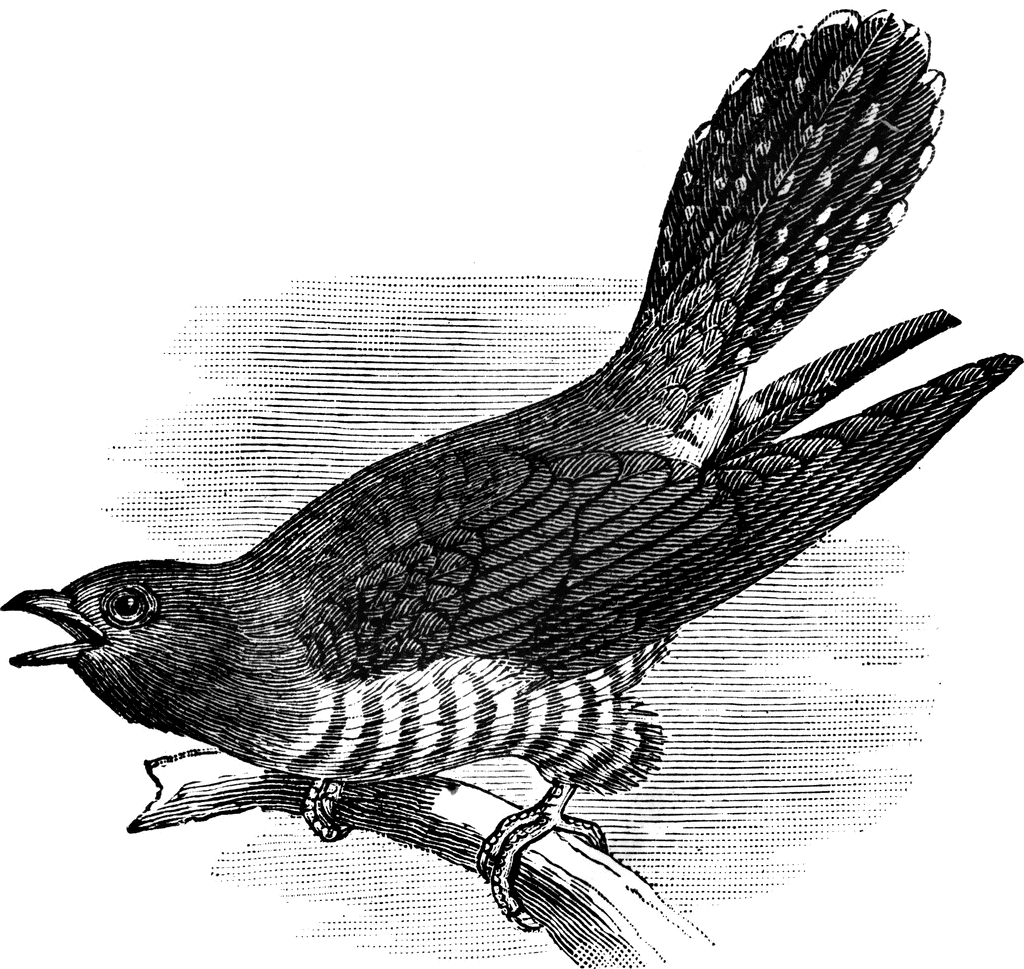
A cuckoo bird could be seen as an odd inspiration for business success.
I mean, they’re also shameless parasites - who wants to be a part of that?
You see, many species of cuckoos have been known to leave their eggs in other birds’ nests. Their whole means of success depends on letting their young be raised by entirely different species.
Ornithologists used to think that cuckoos would simply wait for the opportune moment to lay their eggs in other birds' nests, but it turns out that cuckoos have more moxie than that.
In a study in the journal Ethology, researchers from the University of Granada found that the Great Spotted Cuckoo laid its eggs in the nests of magpies while the magpie was sitting on the nest. These researchers thought that magpies had just gotten sick of raising these ungrateful cuckoo birds and started sitting on their nests almost constantly while they were incubating their own eggs.
In Darwin-esque brinkmanship, the cuckoo basically called the magpie’s bluff and went for the crazy (cuckoo, if you will) option, laying eggs in another bird’s nest while the bird was still sitting there.
Even when magpies fought back with aggressive pecking, in every single instance, the cuckoo accomplished her mission and laid her eggs.
That is some moxie.
Which brings me to business models, LVMH, and Bernard Arnault.
Just this week LVMH announced that it had purchased the American icon Tiffany for $16.6 billion adding to his sprawling luxury goods empire.
The Financial Times reports the acquisition is the latest in four decades of voracious dealmaking by Arnault and marks the luxury sector’s largest deal ever. Tiffany, known for its robin’s egg blue boxes, will join a stable of LVMH brands that has diversified far beyond its roots in Christian Dior couture, Louis Vuitton luggage, and Hennessy Cognac to include Rimowa suitcases, make-up by pop star Rihanna, and even train journeys across Europe on the Venice Simplon-Orient-Express.
“Arnault is like a cuckoo: he moves in and takes over others’ nests rather than building his own,” says Dana Thomas, author of Deluxe: How Luxury Lost Its Lustre.
Arnault has never stitched a bag, designed a ring, or launched a product - he and his team have simply made them better.
Going from zero to one sounds sexy and will get you on the cover of magazines, but a better move might be to innovate and make something better.
Anyone who has launched a new product and tried to sell it knows how challenging this process is - even for the best funded, best organized blue-chip companies.
Thomas Steenburgh, a marketing professor at the University of Virginia Darden School of Business, was inspired by his early career at Xerox to discover why firms with stellar sales and R&D departments still struggle to sell new innovations. The answer, he finds, is that too many companies expect shiny new products to sell themselves.
Steenburgh penned this in the November–December 2018 issue of Harvard Business Review: "Successfully executing an organic growth strategy requires a deep and lasting commitment from the entire senior leadership team, because bringing new-to-the-world products to market transforms selling organizations as much as it transforms buying organizations. The best companies are strategically aligned, from the sales force to the C-suite, when new products are launched. They recognize that selling these products involves different barriers, and they develop new processes to overcome them."
In today's global business environment, it is clear the best companies must field the right resources—the know-how, technology, processes, and people—in the right way if they are to have any chance of generating consistent, healthy levels of growth.
Build, Borrow, or Buy: Solving the Growth Dilemma, by professors Laurence Capron, of INSEAD, and Will Mitchell, of Duke University’s Fuqua School of Business, is one of my favorite business books exploring tactics for positive revenue generation.
The book is an examination of the three fundamental modes—or “pathways”—for obtaining the resources needed to grow. They are developing the needed resources internally, or “building” them; contracting or partnering to obtain resources, or “borrowing” them, and acquiring, or “buying” them.
According to the authors, companies should be adept at all three.
From my own business experience as an entrepreneur and consumer, the best organizations can innovate, create, and aggregate as needed - recognizing that these three tools working in concert are powerful.
-Marc
Marc A. Ross is a business strategist and communications advisor working at the intersection of globalization, disruption, and politics. Ross is the founder of Brigadoon.
US election campaigns target phone contacts

Tim Lim, a former Democratic digital adviser, said: “The 2020 campaigns are going to be targeting not just you but your friends. It is not just about who you are, it is who you are connected to.
FT reports, Politicians no longer just want your donation or your vote: they want your contacts book too. With just a year to go until the next US presidential election, both Democrats and Republicans are developing technology that allows them to nudge potential voters via their supporters’ personal networks, thereby potentially bypassing large social media platforms.
So-called “relational organizing” apps, which were first used by the Trump campaign in 2016, are now being used by campaigns on both sides to access the phone contacts of consenting supporters and cross-reference them against voter databases.
Read the full article here: https://on.ft.com/2rGITKZ